Barefoot Running in Grand Rapids August 29, 2011 No Comments

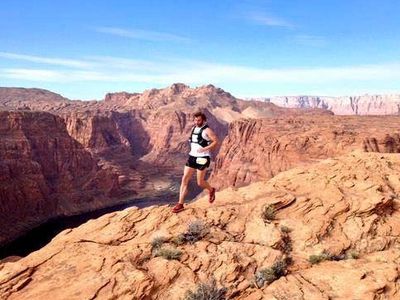
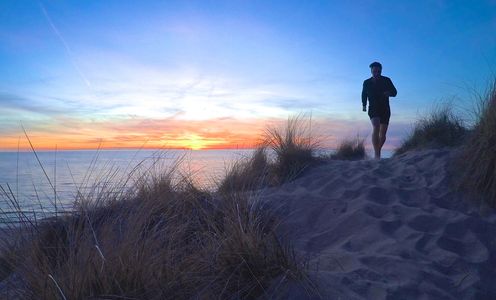
The Hadley Clinic was recently featured on the front page of the Grand Rapids Press.  The article focussed on the benefits of barefoot running and featured Scott Hadley along with a few other local barefoot runners.  You can read the whole article HERE.

Barefoot running has been shown to be much gentler on the body than other forms of running.  A different landing technique, a different posture, and shorter steps allow the body to absorb shock more efficiently and with much less strain on joints and muscles.

Many runners have tried barefoot running with improper form and have gotten injured.  So if you are interested in the benefits of barefoot running, you MUST learn proper form.

Contact the Hadley Clinic if you want to learn how to run barefoot.  Private and group lessons are available and reasonably priced.

Contact the Hadley Clinic at 616-401-2785 for more info.

Plantar Fasciits No Comments

The plantar fascia is a thick band of connective tissue that connects the heel to the toes.  It supports the arch of the foot and plays an important role in foot function.  A lot of foot pain is attributed to inflammation of the plantar fascia – AKA plantar fasciitis.

The interesting thing is that scientific and medical studies have shown that, in most cases of plantar fasciitis, there is nothing wrong with the plantar fascia.  So where is the pain coming from then?

Read the rest of this entry »

Treatment for Cerebral Palsy June 1, 2011 No Comments

Cole (click here for the video!)

One of the most limiting problems with cerebral palsy is tight calf muscles that prevent the heel from touching the ground.  If walking is possible, most people with CP spend their entire life on their toes.  This causes foot deformities, balance problems, and pain.   It has been widely accepted by the medical community that the only way to treat the tight calf muscles is through surgery and/or serial casting to get the ankle to a more neutral position.

Neuromuscular Manipulative Therapy (NMT) is a conservative treatment that helps muscles relax naturally by manipulating the nervous system through activation of reflexes (called heteronymous stretch reflexes) that control movement.

Here is a video clip of a boy with cerebral palsy affecting the right side of his body.  Since he was an infant, his right ankle has been in a brace, he has had several serial castings, and more than one surgeon has suggested an achilles tendon lengthening procedure – all in an attempt to get his heel to the ground when he takes a step.  This is the first time in his life that his ankle relaxed enough to allow his foot to assume a normal posture when he stands on his right leg!


Rotator Cuff Solution! May 11, 2011 No Comments

The rotator cuff is made of 4 small muscles that anchor the “ball” into the “socket” of the shoulder.  Several bigger muscles (pectoralis major, latissimus dorsi, deltoid) are responsible for most of the shoulder’s power, but they can’t operate normally without the rotator cuff muscles.

Since the rotator cuff muscles are small, they are prone to injury.  If one or more of the rotator cuff muscles becomes injured, the group of muscles reflexively tightens to limit shoulder movement.  It’s called “muscle guarding” and is basically a muscle spasm to help prevent further injury.

Read the rest of this entry »

Strength Training for Runners April 27, 2011 No Comments

“We knew we could run in the mud because of our strength training,” said the coach of the Coatesville, Pennsylvania  high school boys cross-country team after they won the 2006 Nike Team Nationals on a wet and muddy Portland Meadows 5k course (Sports Illustrated 105(23): 48, 2006).

It’s a common misconception that the best way to run faster and further in a race is to run faster and further during training.  While nothing can replace the base miles needed for good running performance, running is not the only thing we need to run well.

Here is a little evidence for you from a few studies that have been done on the topic of strength training for runners…

Read the rest of this entry »

Trail Running April 14, 2011 No Comments

A while ago, a running shoe company asked me to write a piece on the benefits of trail running for their website.  I did, and you can find it HERE.

I was a little conflicted when I wrote the article for them.  I was conflicted because I don’t like to wear shoes when I run.  I run barefoot.

So why would I, a barefoot runner, write an article for a shoe company?  The answer is simple:  I like shoes and what they can do for us – if we learn how to use them appropriately.  There is a right way and a wrong way.

The wrong way is to rely on the shoe to absorb the shock that your body is intended to absorb.  Landing on the cushioned heel of a shoe seems like it makes sense.  But research shows that landing on the heel dramatically increases the impact of landing.

But it’s possible to run in shoes with good form – a barefoot form of sorts, where the initial contact with the ground is through the front of the foot rather than the heel.

The body’s shock absorption system is incredibly adept when we land properly.  If you are a runner who lands on your heel, you should consider learning a new way to run.  You will be less likely to get injured, and running will be more sustainable long-term.

Oh.  And you need to learn my injury prevention and self treatment methods too….

Run With Brains,

Scott Hadley PhD, DPT


Stretch Reflex 101 No Comments

HERE is a link to a post I made on my blog, TrekoBlog.com, last September.

The video here shows the result of a tight soleus muscle (like the one in the picture).  The soleus is the largest muscle of the calf – and it takes a beating during most of our activities.

RUNNERS are especially susceptible to soleus overuse.

BAREFOOT RUNNERS often experience pain in the soleus while they are transitioning out of shoes or ramping up their miles.

This shows the power of stretch reflexes and the basis of NMT.

A MUST SEE VIDEO!


Roll Hard. Run Fast. March 15, 2011 No Comments

RUNNERS TAKE NOTE:  This is a video from my my running blog, Trekoblog.com.  It shows a few methods to release the muscles of the hip and thigh.  EVERY runner should make these rolling exercises a habit!

Read the rest of this entry »

Sciatica? Get to the root of the problem! March 14, 2011 No Comments

The gluteus medius is the #1 cause of "sciatica" symptoms.

This is a picture of “referred pain” coming from the gluteus medius – a muscle along the outer side of the hip. Pain radiating from this muscle is often labeled “sciatica.” Interestingly, the pain from sciatica usually does not involve the sciatic nerve. If you have been told you have sciatica, there is a good chance this muscle is the main problem.

This muscle is also the culprit with many types of hip pain that radiate into the leg.

Get to the root of your problem with Neuromuscular Manipulative Therapy (NMT),  Dr. Hadley’s trademarked approach to physical therapy.  Call to schedule your free consultation appointment today!  616.401.2785.

Still have pain after your total knee replacement? No Comments

Know anyone with a knee like this? A lot of people are disappointed with their knee replacement. Research shows the number one problem 1 year after a total knee replacement is quad weakness. That problem can be fixed within a few weeks when treated with Neuromuscular Manipulative Therapy (NMT), a trademarked approach to therapy developed by Dr. Scott Hadley.

Schedule a free consultation by calling 616.401.2785.